From K6-2 to homelab
September 27, 2026
In what now feels like the distant past, I got my first PC around 2000, at 15: a modest K6-2 bought by my father. At 16, I took a PC building course at FAETEC. At 17, already studying languages and literature in college, I scraped together some cash and built my first custom PC from scratch, a Sempron, which allowed me to fully experience the fondly remembered yet thorny years of dial-up, ICQ, MSN, IRC, and Napster. Later on, around 2008, I used spare desktop parts to assemble my first home server, running the late Windows Home Server. When I wasn’t reading Gabo or Machado, I was teaching myself network setup and maintenance.
Fast forward to 2015: already settled in my current career as a translator, I acquired an HP ProLiant MicroServer Gen8, and that was when things got serious. I remember that little box humming along on OpenMediaVault, serving media files and handling backups. Over the years that followed, I also experimented with Ubuntu and other Linux distros on the desktop; the server, besides Debian and Ubuntu, saw duty under TrueNAS and Proxmox.
Around 2018, I moved into a larger apartment and, taking advantage of renovations, planned a home network from scratch with Cat6 cabling running through the walls. From 2020 to 2023, I accumulated gear focused on the SMB or prosumer market, especially from TP-Link’s Omada line (a JetStream PoE switch, EAP225 access points, an OC200 hardware controller, and a SafeStream TL-R605 router), along with imported items like an NVIDIA Shield, a Sonos PLAY:1, a few Raspberry Pis, and even an HDHomeRun, back when M2Play distributed it in Brazil. I also experimented with smart home setups: Tuya switches, Sonoff relays, smart bulbs, and an Echo Dot with Alexa.
During the pandemic, I started digging deeper into the technical side of self-hosting. I discovered a delightfully nerdy crowd that does this as a hobby and became obsessed with the endless potential of Docker and defining entire infrastructures in Ansible. I also began managing a few VPS servers, hosting open source web services for storage, media, and utilities for family use, focusing on convenience, privacy, and control.
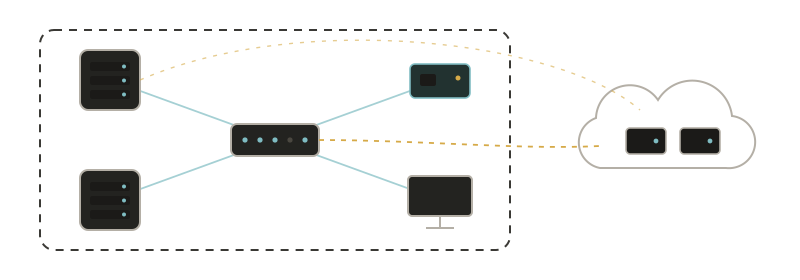
Post-pandemic, after another move, I streamlined the whole setup. Today I run a leaner, much more manageable system: modem, router, and switch; a primary server with 20 TB and a backup server with 2× 2 TB (both running Unraid); a TS Shara rackmount pure sine wave UPS (2U, 1200 VA); and Raspberry Pi boards running AdGuard Home and NUT. I also maintain production services across VPS instances on Oracle and Netcup. This entire infrastructure is defined as code with Ansible: containerized Docker services, backups with restic along with disaster recovery routines, private DNS, an inter-machine VPN, reverse proxying, and monitoring.
In 2025, at age 40, it became impossible to convince anyone (including myself) that this twenty-plus-year flirtation with IT was just a casual fling, so I decided to make it official with a technology degree. I enrolled in Senac’s Internet Systems Technology program, which matched both what I was already doing and what I wanted to build next. Now in my second year, I can say with confidence that it was the right call. My goal was, and remains, to build deeper fluency to develop interdisciplinary projects close to my heart, both personal and professional, right at the intersection of IT, linguistics, and translation, whose most prominent example today is large language models (LLMs). It is hardly a coincidence that, as seen in my projects, I’ve been applying technology across my entire core domain: from literature and journalism, traditionally more analog, to tech-dense specialties like technical translation and subtitling.
If this journey resonates with you, you’d like to bounce ideas around, or you have a project to propose, feel free to reach out through the contact form and let’s take it from there ;)